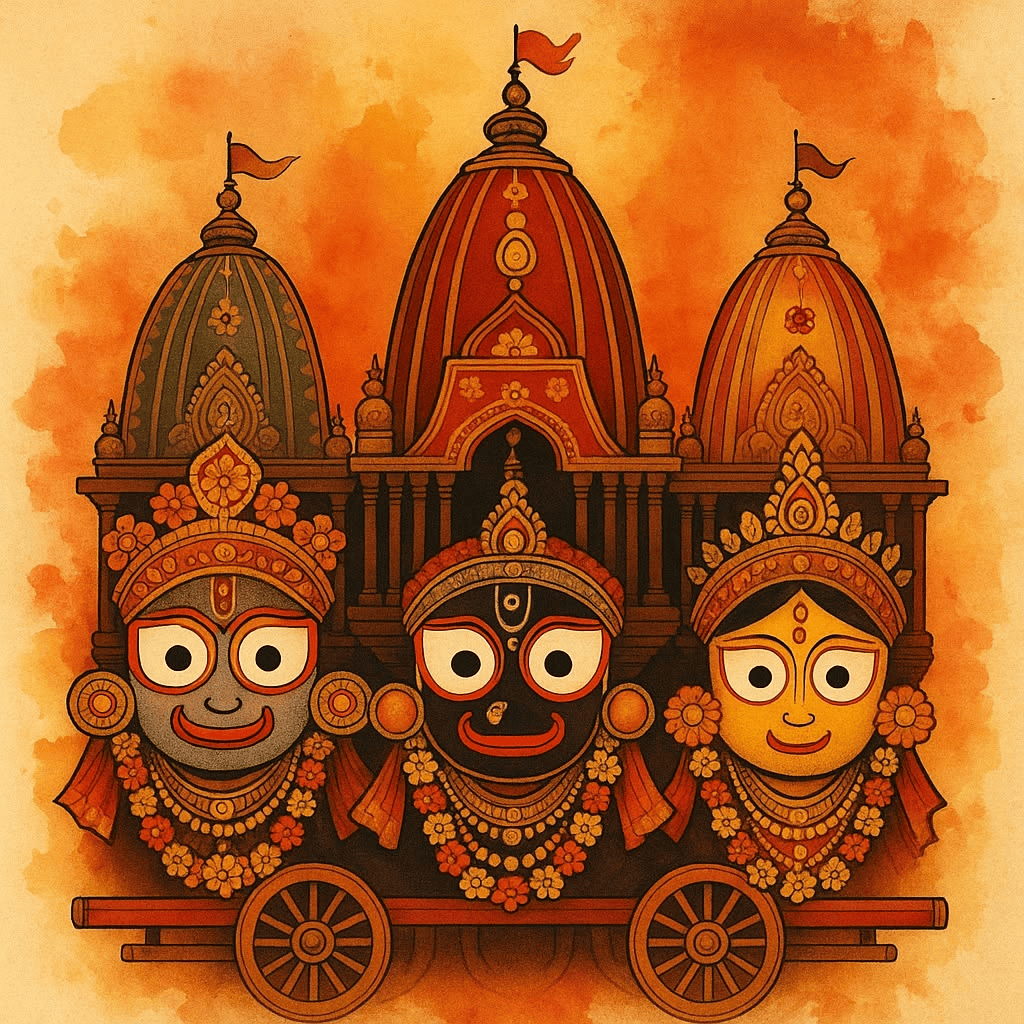
There are festivals that we celebrate, festivals that we observe, and then there are festivals that move millions of hearts across generations. Rath Yatra belongs to the latter.
Every year, devotees eagerly wait for the grand procession of Lord Jagannath, Lord Balabhadra, and Devi Subhadra. They gather in overwhelming numbers, not merely to witness a religious event, but to experience something deeply profound the day when God leaves His sanctum and comes out to meet His devotees.
Think about that for a moment.
In most spiritual traditions, human beings undertake pilgrimages, climb mountains, meditate for years, or travel great distances in search of the Divine. Rath Yatra turns that idea on its head. It reminds us that the Divine is not distant or inaccessible. Sometimes, when devotion calls, God Himself steps out to embrace His devotees.
That is the magic of Rath Yatra.
For me, Rath Yatra is much more than beautifully decorated chariots and joyous chants of “Jai Jagannath.” It is a timeless lesson in humility, inclusivity, devotion, and the beautiful philosophy of Sanatan Dharma.
Let us journey together and discover the deeper meaning behind one of the world’s oldest and grandest spiritual celebrations.
Who is Lord Jagannath?
The word “Jagannath” comes from two Sanskrit words:
- Jagat – the Universe
- Nath – Lord or Protector
Lord Jagannath literally means “The Lord of the Universe.”
He is worshipped primarily as a form of Lord Krishna and is accompanied by His elder brother Lord Balabhadra and His beloved sister Devi Subhadra. Together, the divine siblings represent family, harmony, compassion, and universal love.
Unlike many other forms of Bhagwan that are worshipped in temples across India, Lord Jagannath possesses a unique appearance. His large circular eyes, unfinished limbs, and wooden form have fascinated devotees and scholars for centuries.
Yet, perhaps His greatest uniqueness lies in His accessibility. Lord Jagannath belongs to everyone.
He is not the God of one community, one region, or one sect. He is truly Jagannath—the Lord of the entire universe.
The Beautiful Story of Lord Jagannath’s Appearance
The origins of Lord Jagannath are deeply rooted in devotion and divine intervention.
According to ancient traditions, King Indradyumna was an ardent devotee of Lord Vishnu. He had heard of a mysterious and divine form of the Lord worshipped in a distant land and longed to establish His deity for the benefit of humanity.
The king prayed earnestly and was eventually guided by divine instructions to carve the Lord’s form from sacred neem wood.
The celestial architect Vishwakarma agreed to undertake the task on one condition—he must work in complete seclusion and remain undisturbed until the carving was complete.
Days passed.
Weeks passed.
Silence prevailed behind the closed doors.
The king grew anxious. Unable to contain his concern, he opened the door before the agreed time.
To everyone’s surprise, the deities appeared unfinished without fully formed hands and feet, yet radiating extraordinary divinity.
The king was devastated and apologised profusely. However, a divine message reassured him that the Lord had chosen to manifest in this unique form.
The lesson?
Divine perfection does not always resemble human expectations.
Sometimes, what appears incomplete to us is complete in the eyes of the Divine.
Why Are the Deities Made of Wood?
Unlike many temples where deities are sculpted from stone or metal, Lord Jagannath and His siblings are made from sacred neem wood.
This symbolism is deeply philosophical.
Wood reminds us that all physical forms are temporary. Just as the human body is mortal, even the deity’s physical form is periodically renewed through sacred rituals.
Sanatan Dharma has always taught us that the body changes, but the soul remains eternal.
The Bhagavad Gita beautifully tells us:
“Just as a person discards worn-out garments and wears new ones, the soul discards old bodies and takes on new ones.”
The wooden form of Lord Jagannath becomes a profound reminder that while forms may change, divinity remains eternal.
The Mystery of Lord Jagannath’s Eyes
Perhaps the most striking feature of Lord Jagannath is His large, round eyes.
Children often ask:
“Why are His eyes so big?”
The answers are beautiful.
His eyes symbolise:
- Universal vision
- Infinite compassion
- Constant awareness
- Eternal protection
Unlike human beings, Lord Jagannath’s eyes have no eyelids.
Symbolically, it represents that He is always watching over His devotees.
He does not sleep when it comes to protecting those who surrender to Him.
No matter where you are in the world, Lord Jagannath sees you—not to judge you, but to lovingly guide you.
What Makes Rath Yatra So Special?
Rath Yatra is unlike any other festival because it reverses the traditional relationship between the devotee and the Divine.
Usually, devotees visit temples.
On Rath Yatra, God visits His devotees.
For a brief period every year, Lord Jagannath leaves His magnificent temple and journeys to the Gundicha Temple, accompanied by His divine siblings.
The streets become His temple.
The sky becomes His ceiling.
The people become His family.
Millions gather not merely as spectators but as participants in a sacred journey.
No invitation is required.
No social status matters.
No distinctions exist.
The Lord of the Universe welcomes everyone.
Why Does Lord Jagannath Visit Gundicha Temple?
According to tradition, the Gundicha Temple represents the home of Lord Jagannath’s aunt.
The Lord visits this temple during Rath Yatra and remains there for several days before returning to His main abode.
Spiritually, this journey represents:
- Love
- Family
- Simplicity
- Accessibility of the Divine
The Lord leaves royal splendour and enters the homes and hearts of ordinary devotees.
It reminds us that true greatness is found not in remaining upon a throne, but in serving and connecting with others.
The Three Divine Chariots
Each deity travels on a magnificent wooden chariot.
Lord Jagannath’s Chariot – Nandighosha
- Sixteen wheels
- Towering and majestic
Lord Balabhadra’s Chariot – Taladhwaja
- Fourteen wheels
- Symbol of strength and righteousness
Devi Subhadra’s Chariot – Darpadalana
- Twelve wheels
- Symbol of compassion and divine grace
These chariots are rebuilt every single year by skilled artisans who follow sacred traditions passed down through generations.
Nothing is mass-produced.
Everything is created with devotion.
Every nail, wheel, and decorative element becomes an offering to the Divine.
Why Are New Chariots Built Every Year?
One of the most fascinating aspects of Rath Yatra is that the chariots are never reused.
Imagine the effort involved in constructing these massive structures every year.
Yet Sanatan Dharma intentionally embraces this practice.
Why?
Because renewal is a fundamental truth of existence.
Life is constantly changing.
Our circumstances change.
Our bodies change.
Our relationships evolve.
The only constant is Dharma.
By rebuilding the chariots every year, Rath Yatra reminds us that change is not something to fear. It is something to honour.
The Symbolism of the Rath
The chariot itself holds profound spiritual symbolism.
Ancient Indian philosophy often compares the human body to a chariot.
The Rath represents our body.
The horses represent our senses.
The reins represent our mind.
The wheels represent our karma.
The rope represents our actions and collective effort.
The Lord seated within represents the Divine residing in each of us.
Rath Yatra teaches us that life is itself a sacred journey.
The question is not whether our chariot moves.
The question is: who is guiding it?
If our senses lead us, we may lose our way.
If Dharma guides us, we move closer to the Divine.
The Blessing of Pulling the Rath
One of the greatest blessings associated with Rath Yatra is the opportunity to pull the chariot.
Devotees eagerly wait for this sacred moment.
Why is it considered so auspicious?
Because it symbolises participating in God’s journey.
When thousands of people come together to pull the Rath, they demonstrate something beautiful: that no single person can move the Lord’s chariot alone.
It takes collective devotion.
It takes humility.
It takes service.
Rath Yatra quietly teaches us that humanity progresses only when we pull together.
The King Who Sweeps Before the Lord
Among all the rituals of Rath Yatra, one remains my personal favourite.
The Gajapati King of Puri performs the ritual known as Chhera Pahanra.
During this ritual, the king sweeps the path before the Lord’s chariot using a golden broom.
Pause and think about that.
A king bows before God and performs the role of a humble servant.
What a beautiful lesson for our times.
Titles fade.
Power fades.
Wealth fades.
Only humility remains eternal.
Sanatan Dharma has always placed seva above status.
No matter who we are, before the Divine, we are all devotees.
Rath Yatra and Inclusivity
Lord Jagannath is often called the most inclusive form of God worshipped in India.
His festival welcomes:
- Children
- Elders
- Scholars
- Labourers
- Saints
- Kings
- Tourists
- Devotees from every part of the world
The Lord does not ask:
- Which language do you speak?
- Which community do you belong to?
- How much wealth do you possess?
He simply invites you to come.
The message is powerful.
The Divine belongs to everyone.
Nabakalebara – The Renewal of the Divine Body
One of the most sacred traditions associated with Lord Jagannath is Nabakalebara.
The word means “new body.”
At specific intervals determined by the lunar calendar, the wooden deities are ceremonially replaced through highly sacred rituals.
The old form is respectfully retired, and the Lord assumes a new body.
This extraordinary tradition beautifully mirrors the teachings of the Bhagavad Gita regarding the immortality of the soul.
Nothing could illustrate the philosophy of Sanatan Dharma more elegantly than this sacred ritual.
Mahaprasad – The Food Blessed by the Lord
Lord Jagannath is equally famous for His Mahaprasad.
Prepared traditionally and offered to the Lord, Mahaprasad is considered sacred beyond measure.
What makes it even more beautiful is that it is shared equally among devotees.
No social hierarchy exists in the Lord’s kitchen.
Food becomes an expression of divine grace and equality.
In a world increasingly divided by labels and identities, Mahaprasad reminds us that all beings are equal in the eyes of God.
Five Life Lessons from Rath Yatra
1. God is Accessible
You do not need perfection to seek God. The Divine is always willing to meet you where you are.
2. Humility is Strength
The king himself sweeps before the Lord’s chariot. True greatness lies in service.
3. Change is Natural
The annual construction of chariots and Nabakalebara teach us to embrace change with grace.
4. Community Matters
Thousands pull the Rath together. Collective effort creates extraordinary outcomes.
5. Life is a Journey
Your body is your chariot. Your values determine its destination.
What Every Parent Should Tell Their Child About Rath Yatra
Children often understand spirituality better when it is explained simply.
Tell them:
- Lord Jagannath loves everyone.
- God does not stay only inside temples.
- Being kind is a form of devotion.
- Helping others is seva.
- Humility makes us beautiful.
- Sharing makes us richer.
- God is always watching over us with love.
And perhaps the most beautiful lesson of all:
“You do not always have to go looking for God. Sometimes, God comes looking for you.”
Why Rath Yatra Continues to Inspire Millions
For centuries, Rath Yatra has transcended geography and generations.
Today, it is celebrated across the world.
Yet despite its grandeur, the heart of Rath Yatra remains remarkably simple.
It is a festival that teaches us:
- Devotion without discrimination.
- Service without ego.
- Love without boundaries.
- Spirituality without exclusion.
It reminds us that God is not confined to temple walls or philosophical debates.
The Divine walks among us in our acts of kindness, humility, and collective devotion.
Conclusion
Rath Yatra is not merely the movement of a chariot through the streets of Puri.
It is the movement of the Divine through the hearts of humanity.
The Lord of the Universe willingly leaves His throne, sits upon a wooden chariot, allows ordinary devotees to pull Him through crowded streets, and reminds us that love is the highest expression of spirituality.
In today’s world, where we are constantly running after success, validation, and material achievements, Rath Yatra gently whispers an ancient truth God is not distant.
He is waiting for us.
Sometimes, all we need to do is hold the rope of devotion and walk alongside Him.
So, the next time you hear the chants of “Jai Jagannath,” remember that you are witnessing much more than a festival.
You are witnessing a beautiful declaration made by Sanatan Dharma thousands of years ago:
The Divine belongs to everyone.
And sometimes, the Lord of the Universe comes looking for His devotees.
Jai Jagannath.


Leave a Reply